
AI products built by Automus to extend Oracle Fusion. FAiS powers a family of AI solutions that address common enterprise application challenges through intelligent automation, actionable insights, and new capabilities.

FAiSAccelerate is an AI-native platform that runs the Oracle Fusion lifecycle. It configures the applications, converts legacy data, builds the integrations, extensions and reports, authors the deliverables in the Automus format, and manages the whole program from Initiate to post go-live. Consultants review and sign off. They stop typing.
On a modeled large release, FAiSAccelerate cuts the implementation timeline by about 30%
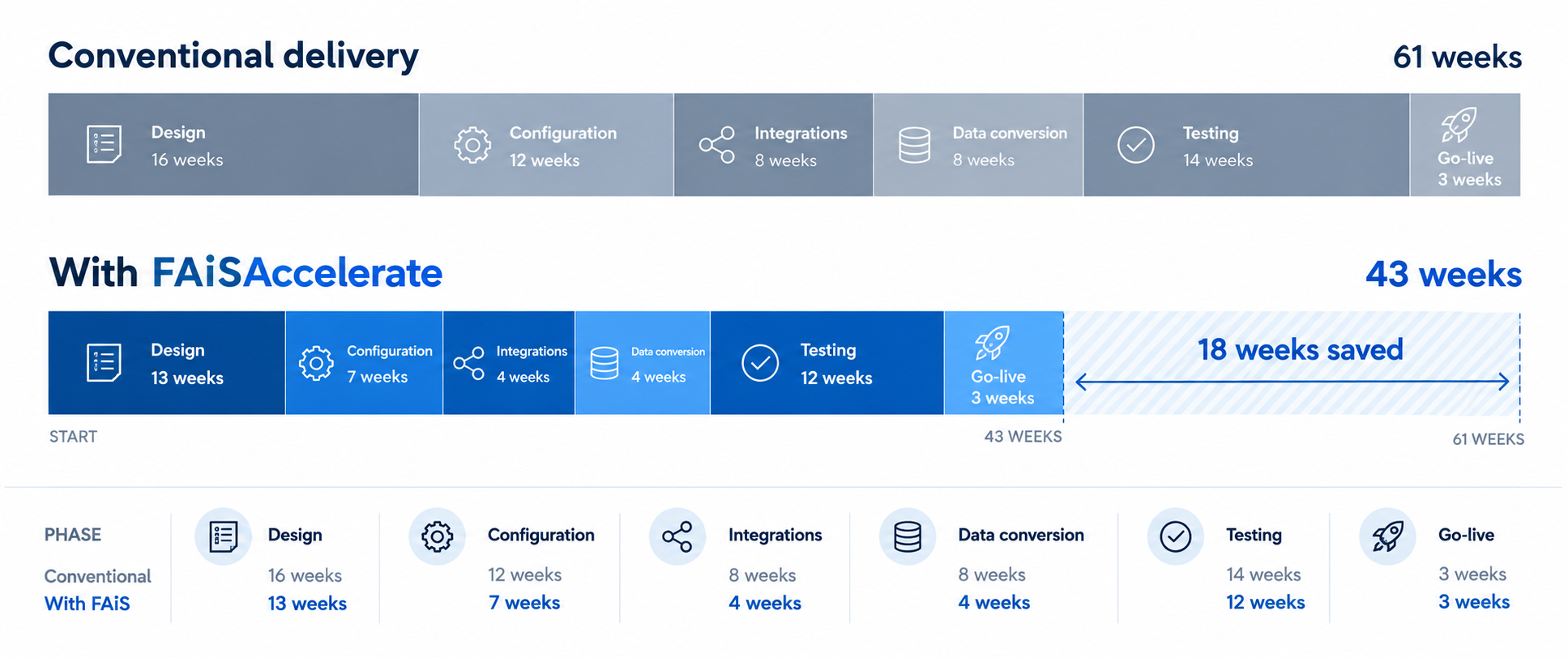
Figure 1: Give the program 18 weeks back. On a modeled large release, FAiSAccelerate cuts the implementation timeline from 61 weeks to 43 weeks.
Inside Accelerate





FAiSConfig
Reads the approved configuration workbook and executes roughly 70% of Oracle setup directly through the REST API, with a human approval loop on every artifact and setup metadata pulled from the live instance.
FAiSConvert
Legacy conversion end to end: AI field mapping, cleansing, FBDI pre-validation and reconciliation. Also available standalone.
FAiSDevelops
Generates OIC integration flows and VBCS extensions from the technical design document, reviewed before anything deploys.
FAiSReports
Builds OTBI and BI Publisher reports from a report design document through five quality gates, with pixel-level layout fidelity. Proven at Jenne.
FAiSDocs
Authors functional and technical design documents, configuration workbooks and status reports in the Automus format, drafted from the statement of work and updated from meeting transcripts.
FAiSPresent
Generates steering committee, phase gate, RAID and weekly status decks from live program data. Narrative written from your numbers only, never invented figures. Editable PowerPoint in seconds.
AskFAiS
A copilot embedded everywhere that knows the program, answers questions about it, and carries a request from intent to finished artifact.
FAiSConnect and FAiSOps
Performance testing during build, and steady-state agents after go-live.